About us
Who we are
Slow Food Canada brings together the communities, conviviums, thematic networks, producers, fishers, cooks, educators, activists, partners, and citizens who keep the Slow Food movement alive across the country.
We are an integral part of the international Slow Food movement, a global network of local communities and activists committed to good, clean, and fair food for all.
In Canada, our role is to connect local initiatives, support regional and thematic networks, develop national projects, and amplify Canadian voices both domestically and within the international movement.
We are currently working to transition to a territorial, project-based organization, in collaboration with the Slow Food Foundation. This transition aims to strengthen the capacity of the Canadian network, better support local communities, and contribute to the movement's international priorities.
Our Vision
We work for communities and a world where everyone has access to food that is good for them, good for the people who produce it, and good for the planet.
Our Mission
We cultivate, develop, connect and support Canadian Slow Food communities, convivia, thematic networks and initiatives and projects of the movement across the country.
Our Action Pillars

DEFEND BIOLOGICAL AND CULTURAL DIVERSITY.

EDUCATE, INSPIRE AND MOBILIZE THE WORLD AROUND US.

INFLUENCE PUBLIC DECISION-MAKERS AND THE PRIVATE SECTOR.
Our Shared Values
GOOD
We advocate for delicious, healthy and culturally appropriate food as a right for all.
CLEAN
We support local and resilient food systems that regenerate the earth's precious resources instead of depleting them.
FAIR
We are creating economies based on solidarity and cooperation that allow all agri-food workers and all consumers to take charge of their own lives.
Our history
Slow Food has been active in Canada since 2000, with the creation of the first conviviums in Montreal and Vancouver. The Canadian coordination of the movement, now led by Slow Food Canada, was established at the movement's first Canadian meeting in Montreal in 2005, under the leadership of Sinclair Philip, international concillor, and Mara Jernigan, founding president.
Since then, the movement has taken root in several regions of the country through local communities, conviviums, Earth Markets, thematic networks, biodiversity projects, educational initiatives, advocacy campaigns, and the formation of Canadian delegations to major international Slow Food gatherings.
The Canadian network reflects the diversity of the country's food territories: fisheries and coastal communities, local farms and markets, regional cuisines, Indigenous knowledge, wild foods, artisanal products, languages, cultures, and the social realities specific to each region.

From left to right: Sinclair Philip, Carlo Petrini, Normand Laprise and Françoise Kayler
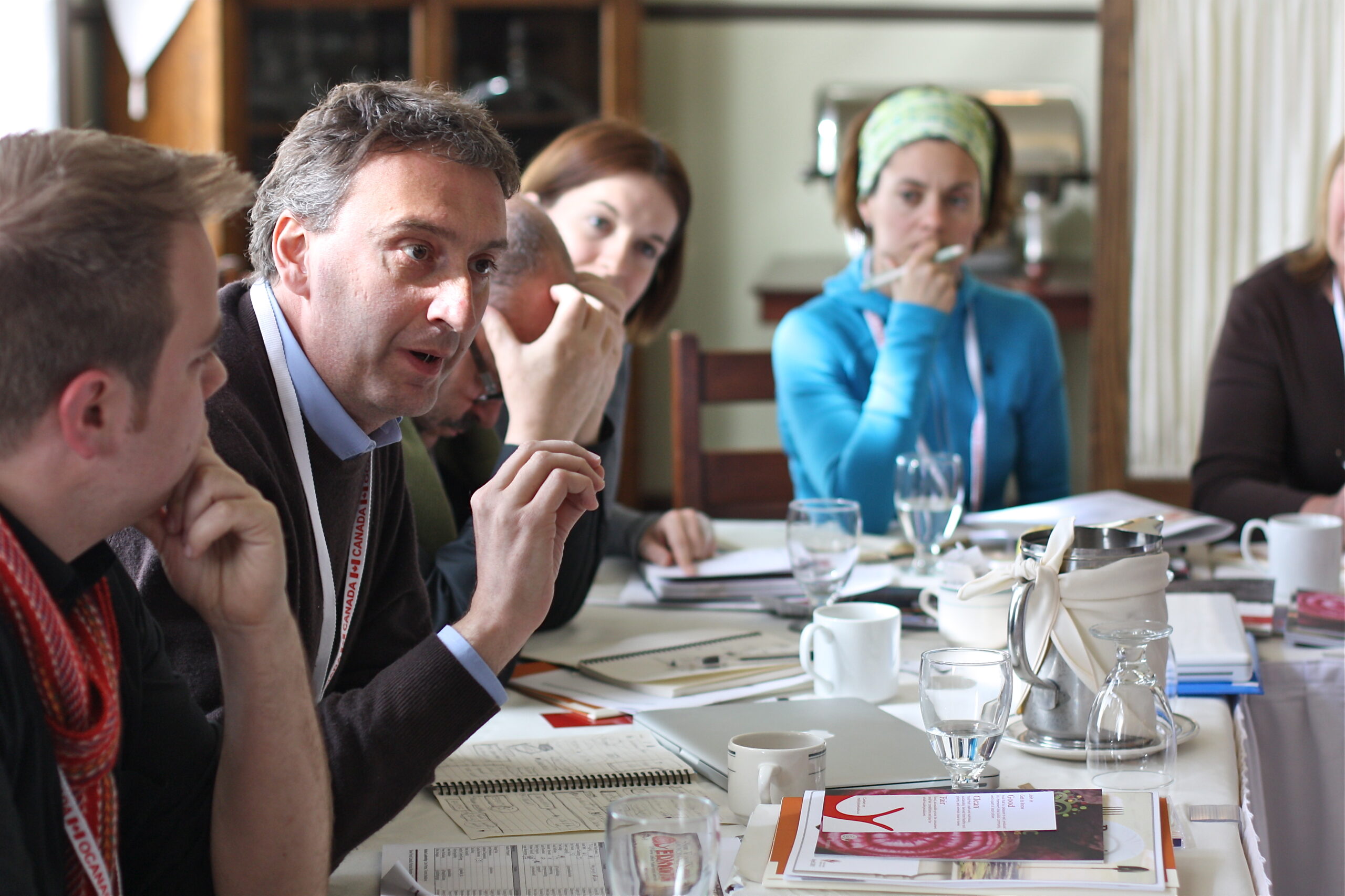
From left to right: Bobby Grégoire, Paolo Di Croce, Sinclair Philip, Lilia Smelkova et Jodi Belluz.
Our National Structure
Slow Food Canada is the growing national network of the Slow Food movement in the country. It acts as a space for coordination, support, and representation for local communities, thematic networks, commissions, and national projects, in connection with the Slow Food Foundation and the international movement.
Our current structure is based on national coordination, local communities and convivia, Earth Markets, thematic networks, Canadian commissions, and structuring projects.
Slow Food Canada is coordinated by Bobby Grégoire, Slow Food International Concillor for North America – Canada. This coordination supports the development of the network, assists regional leaders, facilitates connections with Slow Food International, and contributes to representing the Canadian voice in the movement's international forums.
The coordination relies in particular on the establishment of an advisory committee of national leaders and three Canadian commissions, which bring together the network's strengths around the three main pillars of Slow Food action:
- the Canadian Commission on Biodiversity;
- the Canadian Commission on Taste Education;
- the Canadian Advocacy Commission.
Our Canadian Priorities
(RE)CONNECT
We cultivate links between Slow Food communities, regional leaders, thematic networks and committed individuals across the country.
CELEBRATE
We recognize the individuals, projects, knowledge and communities that contribute to advancing good, clean and fair food for all.
TO ACCOMPANY
We develop tools, training, resources and spaces for exchange to support activists, leaders, producers, fishermen, cooks and educators in the network.
Take part in the mouvement
Slow Food Canada is a network open to individuals and organizations who want to contribute to good, clean, and fair food for all.
You can get involved as a citizen, activist, producer, fisher, cook, educator, researcher, organization, institution, committed business, or partner.
You can join an existing community, participate in a national project, create a new Slow Food community, propose a collaboration, or support the development of the Canadian network.
Contact-us
Get in touch
Do you have any questions or comments? Feel free to contact us!

Join the Canadian network of the global movement of local communities fighting for the right to good, clean and fair food for all.
For more information about the Canadian network and to share your ideas
© Slow Food Canada | 2026
WHO WE ARE
About us
HOW WE GET TOGETHER
Our Movement in Canada
WHAT WE DO
Our National Projects
WHAT YOU CAN DO
Be part of the Change
STAY INFORMED
Medias & news
KEEP CONNECTED
Contact us
Slow Food Canada acknowledges its work on Turtle Island, on unceded Indigenous territories, and on territories subject to treaties, modern agreements, or land claims. We recognize First Nations, Inuit, and Métis peoples as custodians of knowledge, cultures, and living relationships with the land, water, food, and all living things.
This recognition guides our commitment to supporting the voices, knowledge, and leadership of First Nations, Inuit, and Métis peoples within our networks, projects, partnerships, and evolving governance, in dialogue with the Indigenous Advisory Committee of Slow Food International.